Why I am not traditional.
But wish I could be.

"I've been drawing comics full-time—like, every single day—for just over a year now. It's the first time I’ve been doing it for other people, too. Real work-for-hire stuff. Pages with deadlines. Characters I didn’t make. Notes. Feedback. The whole thing."
It’s been great. And weird. And intense. There’s this shift that happens when you go from I love comics to I make comics for a living. Suddenly everything gets heavier. The paper, the pencils, the expectations.
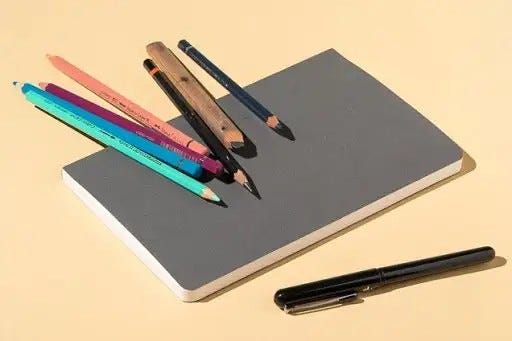
Caption: “Before it was work, it was just me and the paper—now it’s a schedule.”
"I remember early on, buying the big 11x17 Bristol board. The kind you see pros use. Thick, toothy, serious stuff. I tracked down the right pencils, the right leads. I’d look up how my favorite artists did it and try to mimic them."
That’s the romantic version of it, right? You get the mythical tools—the Hunt 102 nib, the blue-line pencil—and maybe you’ll unlock the secret. Maybe your pages will just look like the real thing.
Spoiler: they don’t.
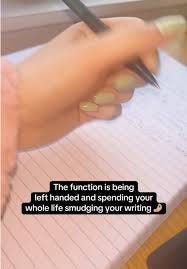
Especially if you’re like me—a lefty. I smudge everything. My pencil work turns muddy fast. All those beautiful underlines you’re supposed to ink over? I end up erasing half of them just so I can see what I’m doing. I tried the mechanical blue pencils, the red leads, the whole thing. Honestly? It made everything messier.
"Then you hit the ink phase. What do you use? A Micron? A nib? A brush? Some fancy Japanese marker with a brush tip? There are so many ways to do it, and they all have their own learning curves."
Years ago, I emailed Ryan Ottley (yeah, that Ryan Ottley) asking what he used. He was kind enough to answer—told me what worked for him. Which were Japanese brush pens.
If you’re curious about trying out traditional tools, I’d recommend:
David Finch on YouTube – if you want to see clean, confident linework
Proko – great for drawing fundamentals that actually translate to comics
Pentel Pocket Brush Pen – just trust me
"But here’s the thing—I couldn’t keep up. Not with real deadlines. Not with revisions. Not with me being... kind of messy and slow. I had to let it go."
I shifted everything into Clip Studio Paint on a Surface Pro. And honestly? It saved me. I can thumbnail, pencil, ink, and revise in layers. I can turn in pages that don’t look like I fought with them. It’s not romantic, but it works.
Here’s my usual process:
Rough thumbnails (loose, ugly, but full of energy)
Tighter pencils (a new layer—still messy, just less)
Inks (finally, the “real” layer)
Fixes (because editors and writers have notes. Always.)
It’s efficient. It's clean. It lets me keep up.
"Still... I miss the traditional stuff. The real pages. The ones you can hold. The ones you can sell."
Here’s a hard truth: artists don’t get paid a ton per page. But if you’re lucky enough to work on a beloved character? That original art becomes valuable. Like, actually sellable valuable. I’d love to have a few of those pages in my portfolio, not just for money—but because they look great. They feel real. People react to them.
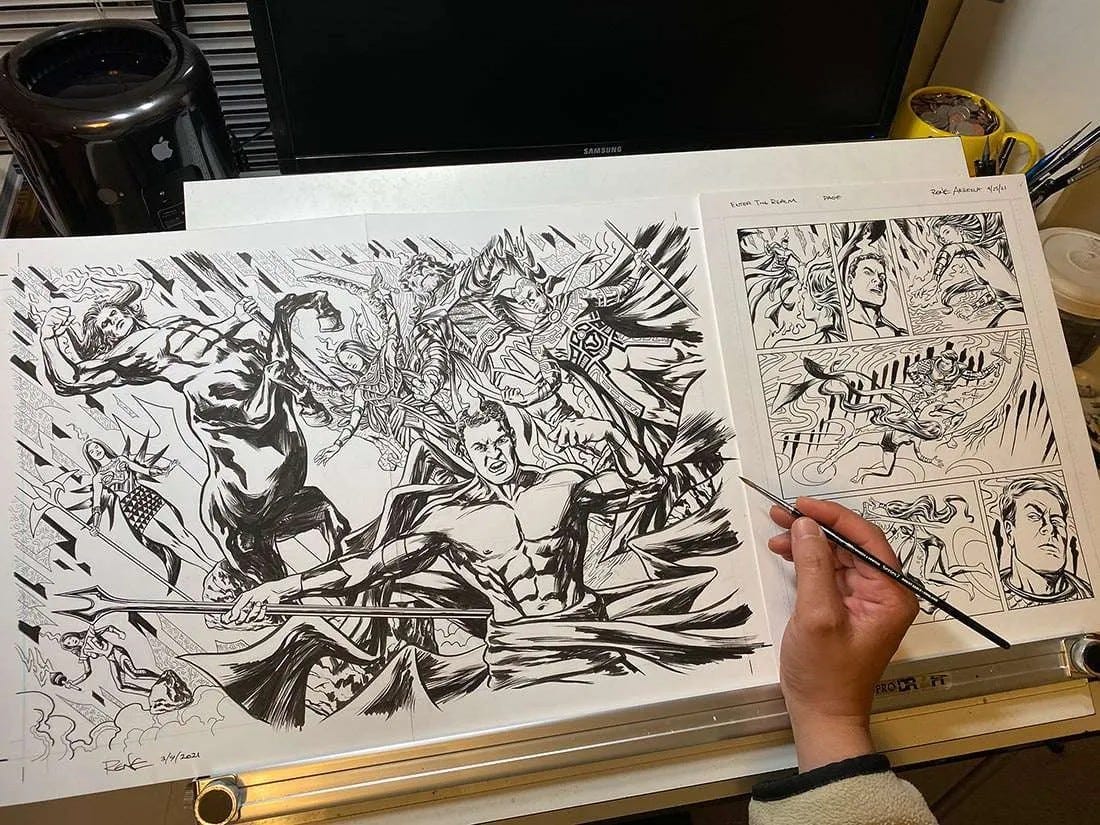
Caption: “People don’t ask to see your Clip Studio files at shows—they want paper.”
"So yeah—someday, hopefully this year—I want to do a fully traditional page again. Start to finish. Just to prove to myself I still can."
It’s not where I’m at right now. The deadlines are too tight. The workflow I’ve built is working. But I’d love a reason—an excuse, really—to break out the Bristol board and make something slow and messy and real.
Until then, I’ll be layering and inking and tweaking on a screen. But the paper’s never too far away.
I understand this 💯 thanks for sharing!